


The Navy Blockade Is On. Here's What You Need to Know.
I'll be honest with you — I hoped I'd be writing a different update this week. The ceasefire was announced on 8 April and for a few days there was genuine optimism that the Strait might reopen. That's not where we are.
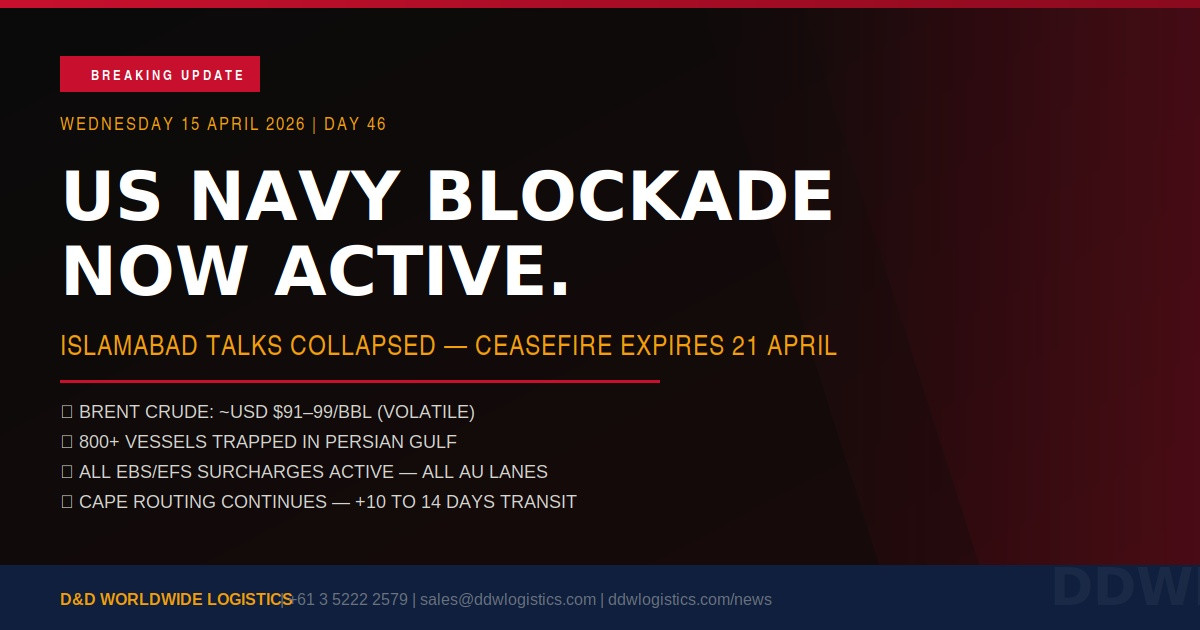
The Islamabad talks collapsed on Sunday 12 April after 21 hours of negotiations. JD Vance flew home without a deal. Within hours, Trump announced that the US Navy would begin blockading Iranian ports — and at 10am Washington time on Monday 13 April, that blockade went live.
That's the situation as of this morning. The Strait of Hormuz is not open. It's now caught between an Iranian-controlled chokepoint and a US naval blockade of Iranian-linked shipping. Either way, commercial shipping is not flowing freely, and that's the reality we're all operating in.
KEY NUMBERS AT A GLANCE — 15 APRIL 2026
Brent Crude: ~USD $91–99/bbl (volatile) Vessels Trapped in Gulf: 800+ AU Diesel vs Feb: +40% Cape Routing Adds: +10–14 days Ceasefire Expires: 21 April
What Actually Happened — Quick Rundown
8 April — A two-week ceasefire was agreed. Iran started letting ships through — but at a price. Literally. They were charging over USD $1 million per vessel in transit tolls. Not exactly reopening the strait in good faith.
12 April — US-Iran talks in Islamabad broke down. The sticking point? Iran wouldn't commit to giving up its nuclear weapons program. The US delegation packed up and left after 21 hours.
13 April — US Navy blockade of Iranian ports and coastal areas began. CENTCOM was clear that this isn't a full closure of the strait — ships going to and from non-Iranian ports can still pass. But in practice, the combination of Iranian mines, IRGC threats, cancelled war risk insurance and now a naval blockade means very few commercial vessels are willing to take the risk.
14–15 April — Oil briefly spiked above $101/bbl Monday before easing to around $91–94 when the White House signalled it might be open to further talks. Nothing's scheduled. A third US aircraft carrier strike group is now heading to the region. The UK is leading a 40+ nation coalition exploring a peaceful minesweeping mission.
⚠ One Thing I Need to Be Clear About
The US blockade is NOT a full closure of the Strait of Hormuz. CENTCOM has confirmed that vessels going to and from non-Iranian ports can still transit. But let me be straight — for practical freight purposes, treat Hormuz as closed. Commercial shipping isn't going through because of mine threats, IRGC activity, and the fact that most war risk insurance on Gulf transits was cancelled back in early March. The legal technicality doesn't change the operational reality.
So What Does This Actually Mean for You?
If you're shipping from or to Australia — whether that's exports to Asia, imports from Europe, food shipments to the Middle East, or anything in between — here's the honest picture.
Ocean freight to Europe, the UK, and the Middle East is now routing via the Cape of Good Hope. Every major carrier — Hapag-Lloyd, Maersk, CMA CGM, MSC, OOCL, ONE, PIL, Evergreen — has pulled out of Suez and Hormuz transits. That adds 10 to 14 days to your transit times and it's not coming back quickly. Xeneta's chief analyst has said plans for any return to the Suez Canal in 2026 are off the table. Eurasia Group says even when Hormuz does eventually reopen, it'll take at least two months for shipping to normalise — and that's the optimistic scenario.
Surcharges are on everything. Every carrier servicing Australia has an Emergency Bunker Surcharge or Emergency Fuel Surcharge active right now. We're tracking all 15+ carriers and not a single one has removed or reduced their surcharge. They range from USD $75 to $975 per container depending on the carrier and trade lane. These are reviewed weekly or fortnightly — so the number your supplier quoted you last week may not be the number we're working with today.
Air freight capacity is squeezed. Dubai and Doha are major hub airports and the airspace situation around the Gulf has slashed belly-hold capacity on Australia-to-Europe routes by around 18%. Spot rates to Europe are up more than 35% since the start of March. If you're moving time-sensitive cargo, you're paying more for it right now.
Your domestic freight costs are up too — and this one catches people off guard. Australian diesel is running about 40% above where it was before all this kicked off. Road fuel levies are recalculated every Monday. If you're getting invoices that look different week to week, this is why. Transport operators don't have a choice — the maths don't work without passing it on.
Food exporters, pay attention. If you're shipping Australian meat, dairy, grain or other food products to the Middle East or North Africa, you're looking at emergency conflict surcharges and war risk surcharges that can add up to USD $4,000 per container. Some carriers are imposing these after cargo has already been accepted. That's an uncomfortable conversation nobody wants to have at the last minute.
“The Strait of Hormuz has not reopened — it is in a supervised pause. Standard shipping lanes remain largely unused, and no meaningful increase in traffic has followed the ceasefire announcement.”
— Windward Maritime Intelligence, 14 April 2026
The Big Question: What Happens on 21 April?
The ceasefire expires in six days. As of this morning the White House has signalled it's open to further talks with Iran, but nothing is booked. Trump has simultaneously been threatening to resume airstrikes on Iranian infrastructure if no deal is reached. It's not a stable situation.
Goldman Sachs put out a note saying if the Strait remains mostly shut for another month, Brent will average above $100/bbl for the rest of 2026 — with Q3 potentially hitting $120. That's not my forecast, that's Goldman's. I'm not an oil analyst, but I know what sustained $100+ oil does to freight budgets.
My view? Don't plan around the ceasefire holding. Plan around it not holding. If we get a genuine deal and the Strait reopens, that's a bonus — but it'll still take months before shipping actually normalises. The backlog of 800+ vessels trapped in the Persian Gulf, the equipment imbalances, the congestion — that doesn't clear overnight even in the best case scenario.
What I'm Telling Every Client Right Now
PRACTICAL CHECKLIST — READ THIS SECTION
✔ Assume your quote is expired. If you haven't had a written booking confirmation from us this week, treat the rate as needing reconfirmation. EBS/EFS rates change weekly. Nothing is locked in until you have it in writing from DDWL.
✔ Check your cargo insurance — seriously. Major P&I clubs cancelled war risk cover for the Gulf, Persian Gulf and Gulf of Oman back in early March. If your cargo is touching the Middle East in any way — even in transit through a Gulf port — confirm your war risk position with your broker before it ships. Carriers are not on the hook for war-related loss. That exposure sits with the cargo owner.
✔ Add time to everything. Cape routing, port congestion, equipment shortages, tighter bookings — it's all stacking up. If you were running just-in-time on any lane affected by this, you need to be adding four to five weeks minimum on top of your normal transit time.
✔ Your 2026 freight budget needs a revision. If your planning was based on late-2025 assumptions, it's significantly undercooked. The Drewry World Container Index is up 14.4% since the conflict escalated. Call us to work through what your actual landed costs look like right now.
✔ Book early and lock it in writing. Space is tight on multiple carriers. The rate you lock in today is today's EBS. Book early, get it in writing, and don't assume last week's numbers still apply.
✔ North America importers — BMSB ends 30 April. FCL containers from North America, Japan or any BMSB-listed country must have a fumigation certificate before sailing. No exceptions. Australian Biosecurity won't take excuses.
Carrier Surcharge Overview — All Active
We track surcharge updates across all carriers servicing Australian trades. Every single one of them has an active EBS or EFS right now — not one has reduced or removed theirs. Here's the short version:
Hapag-Lloyd: Emergency Fuel Surcharge plus War Risk Surcharge active on all AU/NZ lanes.
Maersk: Global Emergency Bunker Surcharge, reviewed every 14 days.
CMA CGM / ANL: EFS activated from loading date 16 March — applies to all FCL cargo on AU/NZ lanes.
MSC: Northbound EFS active since 11 March 2026.
OOCL: EBS ranging from USD $75 per 20ft dry to $975 per 40ft reefer — renewal of previous expiry pending.
ONE, PIL, Evergreen: All have active surcharges across Australian trade lanes. Contact DDWL for your specific route and dollar amounts.
The full breakdown with specific dollar amounts per carrier and per lane is on our website at ddwlogistics.com/news. We keep it updated as notices come in.
I'll keep publishing these updates for as long as the situation requires it. If something changes materially — a ceasefire breakthrough, a new escalation, a significant surcharge change — we'll get something out the same day.
And if you've got a specific shipment you're worried about, a contract renewal coming up, or just want to talk through what this means for your supply chain — pick up the phone or send us an email. That's what we're here for.
Talk to Us Today
We're managing carrier relationships, surcharge tracking and bookings daily. The more lead time we have on your freight, the more options we have for you.
📞 +61 3 5222 2579 ✉ sales@ddwlogistics.com 🌐 www.ddwlogistics.com
All rates confirmed at time of booking only. No rate is fixed until written booking confirmation is issued by DDWL. Emergency Fuel Surcharge (EFS/EBS) applies across all carriers on all Australian and New Zealand trade lanes. This document is for informational purposes only. All business is conducted under DDWL Standard Trading Terms and Conditions. Visit www.ddwlogistics.com for full terms.