


Australia Is Being Hit from Every Direction
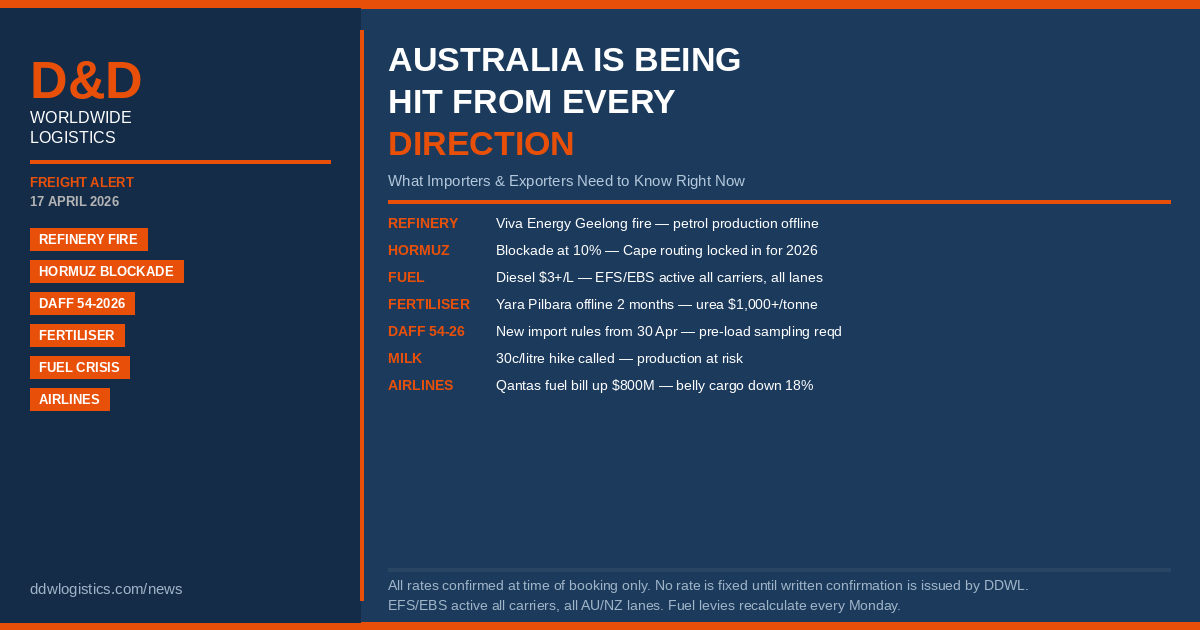
Australia Is Being Hit from Every Direction
D&D Worldwide Logistics | 17 April 2026 | www.ddwlogistics.com/news
I want to be straight with you. What's happening right now isn't one problem. It's a cluster of problems that have all landed at the same time, and each one has a direct impact on the cost of moving cargo into and out of Australia.
Let me walk you through where things actually stand today — the refinery fire in Geelong that happened last night, the ongoing Hormuz blockade, the fertiliser crisis hitting farmers right now, new DAFF biosecurity requirements that kick in on 30 April, what's happening to milk prices, aviation fuel, airlines cutting routes, and what it all means practically for you as an importer or exporter.
THE GEELONG REFINERY FIRE — RIGHT IN OUR OWN BACKYARD
Wednesday night, 16 April, a gas leak ignited at the Viva Energy refinery in Geelong. Sixty-metre flames tore through the plant. Victoria Fire and Emergency Services worked through the night and had it under control by noon Thursday.
The Viva Energy Geelong refinery is one of only two operating oil refineries in Australia. It produces about 10 per cent of the country's fuel. The section of the refinery that was destroyed was the unit producing high-octane petrol. By triggering isolation valves early, other parts of the plant producing jet fuel and diesel were spared the worst. That's some relief — but petrol production from that unit is down until repairs are complete, and no timeline has been set yet.
Viva Energy Geelong produces roughly 10% of Australia's fuel. Petrol production is offline with no confirmed repair timeline.
Prime Minister Albanese, who was in Malaysia when the fire broke out, announced that Australia has secured an additional 100 million litres of diesel from Brunei and South Korea as an emergency measure. That is the first shipment made under the government's new strategic reserve powers. It helps. But it does not fix the underlying problem, which is that Australia imports around 90 per cent of its refined fuel from Asian refineries that depend on crude oil transiting the Strait of Hormuz — the same chokepoint that is currently running at 10 per cent of normal capacity.
Energy Minister Chris Bowen has asked Australians not to panic-buy. Current national reserves sit at approximately 38 to 39 days of petrol, 29 to 31 days of diesel, and 30 days of jet fuel. The government has already underwritten spot-market purchases from Ampol and Viva Energy and activated elements of the National Fuel Security Plan. Over 600 service stations have been affected by supply disruptions across the country.
THE HORMUZ BLOCKADE — NO END IN SIGHT
The ceasefire announced on 7 April has not opened the strait. Iran agreed to stop fighting but made clear it would not reopen Hormuz without a permanent end to the war and guarantees it would not be attacked again. The United States rejected those terms and, on 13 April, announced a full blockade on all maritime traffic entering or leaving Iranian ports.
Right now, shipments through the Strait of Hormuz are running at roughly 10 per cent of pre-war levels. Around 230 fully loaded oil tankers remain stranded inside the Gulf. Major container lines, including Maersk, CMA CGM, and Hapag-Lloyd, suspended Hormuz and Red Sea transits in late February and have not returned. The Houthis in Yemen have also resumed attacks on commercial shipping in the Red Sea, meaning both routes around the Middle East are effectively closed.
The IEA's April oil market report describes this as the largest supply disruption in the history of the global oil market — worse than both 1970s oil shocks combined. Eleven million barrels a day have been removed from the market. Gulf oil exports have dropped from around 24.5 million barrels per day pre-war to 8.7 million barrels per day in March.
Cape of Good Hope routing is the standard for 2026. Add 10 to 14 days to all transit times on Australia–Europe, Australia–UK, Australia–Middle East and Australia–Indian Subcontinent lanes.
Xeneta's chief analyst has publicly stated that plans for any return to Suez or Red Sea routing in 2026 have been shelved. Even if a ceasefire is reached, Eurasia Group analysis confirms it would take at least two months for tanker operations to resume and several months beyond that to repair damaged energy infrastructure in the Gulf. The cargo backlog does not clear quickly.
For Australian importers and exporters: if you are still running just-in-time logistics on any lane that previously routed through Suez or Hormuz, you need to adjust your lead times and push your booking windows out immediately. That window is now.
THE FERTILISER CRISIS — A PERFECT STORM FOR AUSTRALIAN FARMERS
This one does not get the same front-page attention as the refinery fire, but for Australian agriculture, it may be the most serious medium-term issue we face this year. There are actually two separate crises converging at once — a global supply disruption caused by the Hormuz blockade, and a domestic production shutdown that nobody planned for.
Global supply — Hormuz cuts off 43% of urea shipments
Australia imported 3.85 million tonnes of urea in 2024. Around 64 per cent of that came from the Gulf region — Saudi Arabia, the UAE and Qatar. With Hormuz effectively closed, those shipments have stopped. Urea prices have surged from around $675 per tonne in February to over $1,000 per tonne by the end of March, and that was before the full US Navy blockade was announced on 13 April. Some market analysts are now citing prices above $1,800 per tonne in certain markets.
Nearly a million metric tons of fertiliser cargo are physically stranded in the Gulf. Major producers have declared force majeure. And 30 per cent of internationally traded fertilisers normally transit the Strait of Hormuz, so the supply shortfall is global — Australia is competing with the Northern Hemisphere for whatever stock can be sourced from alternative suppliers.
Domestic supply — Yara Pilbara offline for two months
On top of the global disruption, Australia's own largest ammonia plant went offline. The Yara Pilbara facility in Western Australia — which produces 850,000 tonnes of ammonia per year, roughly 5 per cent of globally traded ammonia — suffered a power outage that damaged equipment. The plant is expected to be shut for up to two months. The timing could not be worse.
Australia has almost no domestic urea manufacturing capacity. Incitec Pivot's Gibson Island facility, which was our only urea manufacturer, closed in 2022. The Strike Energy WA replacement facility never broke ground, and the Perdaman Burrup plant is not expected to produce until mid-2027. We are almost entirely import-dependent, and the imports have stopped.
The farm-level reality right now
Most winter grain crops in Australia are sown between April and June. That window is open right now. An AUSVEG survey of more than 180 vegetable growers found that 51 per cent have only three weeks or less of fertiliser supply remaining. Five per cent have less than one week's worth.
GrainGrowers has warned of "serious ramifications" for the 2026 harvest. Farmers who cannot access fertiliser in the next few weeks face a straightforward choice: plant anyway and absorb the cost spike, plant less, or do not plant at all. With fertiliser and fuel together representing 25 to 30 per cent of a cropping business's total farm costs, profit margins have effectively gone to zero or negative for many operations right now.
Former Reserve Bank advisor Alexandra Prokopenko has described the supply shock as likely to manifest in food prices within six to nine months — reduced planting now means lower yields in the third and fourth quarters of 2026, which feeds directly into grocery prices.
DAFF BIOSECURITY NOTICE 54-2026 — NEW FERTILISER IMPORT RULES FROM 30 APRIL
IMPORTANT — Effective 30 April 2026. All fertiliser loaded on or after this date must comply with the new policy. 13 days away.
In the middle of the supply crisis, DAFF has issued Import Industry Advice Notice 54-2026, dated 16 April 2026, overhauling the rules for importing inorganic fertiliser into Australia. The changes take effect on 30 April, which is 13 days from today. If you are importing fertiliser, you need to understand this now.
The previous system separated bulk in-ship and containerised fertiliser into two different policy frameworks, dating back to 2004 and last revised in 2017. Those two policies have now been combined into a single unified policy covering both in-ship 's-hold and containerised consignments. DAFF says the change reflects historically high compliance rates and a desire to reduce regulatory burden — but there are new documentation and inspection requirements that are not optional.
What has actually changed
Vessel Level 1 status now requires no actionable cargo for the last six voyages. Previously, this was based on a rolling two-year history. The change simplifies qualification while maintaining risk control, which is good news for vessel operators with a clean recent record.
Offshore entity registration has been streamlined. Entities already registered as Level 1 for either bulk or containerised product can add the other pathway by request, without a full re-application. New registrations can now cover both pathways in a single application. Importantly, facilities that only store, transport or load fertiliser — with no biosecurity control role — generally no longer need to be registered separately. That reduces compliance overhead for logistics providers who are not directly involved in the biosecurity management process.
Annual offshore audits by DAFF have been replaced with independent third-party audits. Desktop audits are maintained on an as-needed basis. This shifts the compliance burden from the department to the industry and places accountability on the importer to ensure their third-party auditor is qualified and independent.
Sampling — the biggest practical change
On-arrival in-hold sampling has been replaced with a new pre-departure process. Under the new rules, 15-litre samples must be pre-bagged per hold, collected and secured at the load port by a qualified marine surveyor or authorised inspector before the vessel departs. A declaration must accompany each consignment confirming that sample handling and placement met the Loading Sample Inspection Guidelines.
This is a significant operational change. The inspection and quality assurance process now happens at origin — not on arrival in Australia. Importers need to ensure their offshore suppliers and their appointed surveyors are aware of this requirement and are set up to comply before 30 April.
Load sample analysis certificates are now required across all levels
Previously, the requirement for a load sample analysis certificate confirming the material is free from biosecurity risk material only applied to Level 1 shipments. Under the new policy, this requirement extends to all fertiliser levels. If you are importing fertiliser at any classification level, you now need this certificate for every shipment loaded on or after 30 April.
Transitional arrangements
Goods that have already been loaded and are on the water before 30 April 2026 remain subject to the existing import conditions. The new rules apply to goods loaded on or after 30 April. If you have a shipment currently in transit, check your load date and confirm which regime applies.
If you are importing fertiliser and have shipments in the pipeline, contact us now. The new documentation and sampling requirements need to be coordinated with your offshore supplier before loading.
For further information on the policy, contact DAFF at seacargopolicy@aff.gov.au or refer to the Chemical and Mined Fertiliser section of the DAFF website.
MILK PRICES ARE GOING UP — YOU WILL NOTICE IT AT THE CHECKOUT
Australian dairy farmers are in a serious cost squeeze right now, and it flows directly from the fuel and fertiliser crisis. The industry group eastAUSmilk, representing dairy farmers in Queensland and New South Wales, is calling for an immediate 30-cent-per-litre increase in supermarket home-brand milk prices.
The numbers are stark. Urea for pastures has gone from $800 to $1,800 per tonne in some markets. Diesel on the farm is running above $3 per litre, up from under $2 a few weeks ago. One New South Wales dairy farmer reported it cost him $8,500 to fill his on-farm fuel tank — more than double his normal bill.
Australia's milk production is already running 1.2 per cent below last season, making it the only major dairy-exporting nation recording a contraction this year. Store-brand milk currently sits at $3.30 for two litres. The industry is saying two litres cannot realistically sell for less than $4.00, given current input costs. Farmers who cannot absorb these costs will cut production or exit the industry. Less milk in the system means higher retail prices — and that is coming regardless of what happens with Hormuz in the short term.
For exporters of Australian dairy products, international freight costs are up as much as 50 per cent since the conflict began. Reefer cargo faces added risk from extended Cape transit times. Some exporters have already shifted to East Coast North American gateways just to keep product moving — at added cost and complexity.
AVIATION FUEL AND AIRLINES — AIR FREIGHT IS UNDER PRESSURE
Jet fuel has roughly doubled in price since the conflict began, from around $85 to $90 per barrel to between $150 and $200 per barrel. Fuel accounts for up to 25 per cent of airline operating costs. That hit is enormous, and it is coming through directly in both passenger fares and air freight rates.
Qantas has revised its fuel bill for the second half of 2026 upward from $2.5 billion to between $3.1 and $3.3 billion. Virgin Australia is looking at an additional $30 to $40 million in fuel costs and has cut capacity by 1 per cent in the fourth quarter. Internationally, Scandinavian Airlines cancelled over 1,000 flights in April alone after cutting several hundred in March. Air Asia Malaysia cut 10 per cent of flights across the group.
For air freight into and out of Australia, the practical consequence is reduced belly-hold capacity. Emirates, Etihad and Qatar Airways — who carry a significant share of belly cargo on Australia–Europe lanes — are still not operating normal schedules. Belly-hold capacity on those lanes is down approximately 18 per cent from pre-conflict levels. Spot air freight rates to Europe have increased more than 35 per cent since 1 March.
If you are shipping time-sensitive cargo to Europe or the UK by air, plan for higher costs and reduced availability. Talk to us before booking — there are routing options that may not be your first instinct but can work better in the current environment.
WHAT THIS MEANS FOR YOUR IMPORTS AND EXPORTS RIGHT NOW
I want to keep this practical and direct.
If you are importing from Europe, the UK, the Mediterranean, or anywhere that previously routed through Suez or Hormuz, add at least two weeks to your expected arrival time. Cape routing is the standard. Schedule reliability is down, carriers are rolling containers, and vessel availability on some lanes is tightening heading into Q2.
If you are exporting food or agricultural products, you need to review your supply chain position now if you have not done so already, since the conflict started. Reefer and fresh product faces spoilage risk from extended transit times. Some exporters are already re-routing. Call us if you have not looked at this yet.
If you are importing fertiliser from the Middle East, you need to do two things immediately. First, review your supply pipeline and source alternatives now — do not wait for the Hormuz situation to resolve, because there is no timeline on that. Second, make sure your offshore suppliers and marine surveyors are ready to comply with the new DAFF requirements that take effect on 30 April. Shipments loaded on or after that date that do not have the pre-bagged samples, surveyor declaration, and load sample analysis certificate will face intervention issues on arrival in Australia.
Emergency Fuel Surcharges and Emergency Bunker Surcharges are active across every major carrier on every Australian and New Zealand trade lane. These reset every Monday. They stack on top of existing GRIs. Rates move fast right now. What I quote you today may not be what I can hold next week. That is the honest reality of the market we are operating in.
OUR COMMITMENT TO YOU
We are working every day to get you the best rates, the best routing options, and the most current information we can find. Every surcharge we pass on, we pass on transparently and with as much notice as we can give. Every update we publish reflects what we are actually seeing and hearing from carriers, agents and industry.
Our job is to make your job easier. Right now, that means telling you the truth about what is happening and helping you navigate it.
If you have a shipment moving, a quote you need, a fertiliser import in the pipeline, or you just want to understand how any of this affects your specific supply chain — call us or send us an email. That is exactly what we are here for.
Daniel Fanning
Managing Director — D&D Worldwide Logistics Pty Ltd
daniel@ddwlogistics.com | +61 3 5222 2579 | www.ddwlogistics.com